Garden persimmons, monkeys, and hoshigaki
Around Yugawara, a persimmon tree left heavy with fruit feeds the local macaque troop, so the town asks owners to pick early. Picked early, an astringent tree still makes good hoshigaki if it dries slowly.
By Matt Ketchum, founder and editor
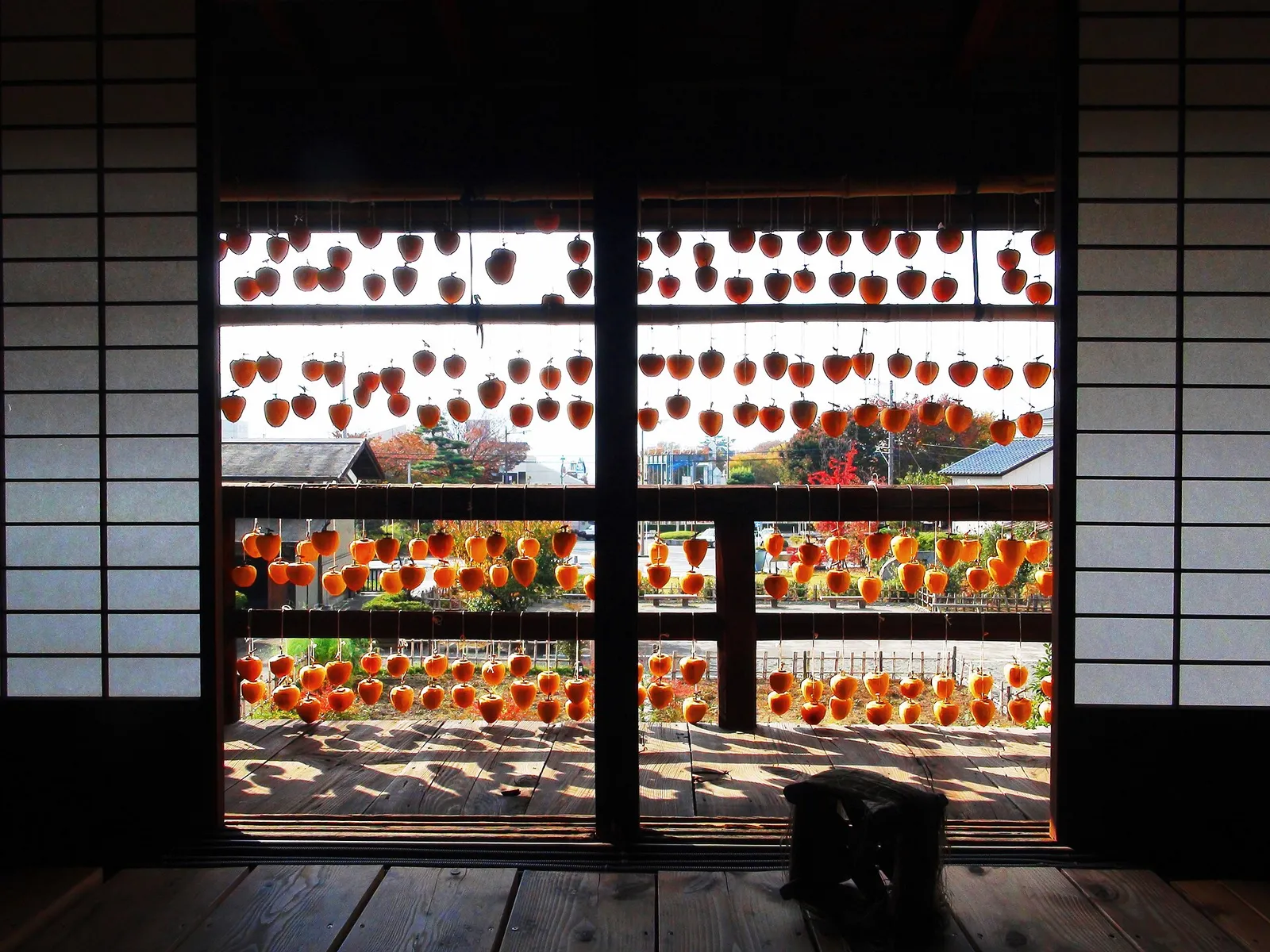
Image credit: Dried persimmons at Kanzo Yashiki, Koshu by さかおり (Sakaori), CC BY-SA 3.0
TL;DR
Yugawara Town asks residents to pick fruit from garden trees early, before its best moment, because wild macaques come down for it. In the town’s 2025 survey, 318 damage reports were of fruit taken from garden trees, with persimmons and chestnuts named among the losses.
Astringent persimmons are the usual fruit for hoshigaki, dried persimmons. Kanagawa’s agricultural technology center says drying is also what removes the astringency, so the fruit has to dry slowly in settled weather; fast machine drying leaves it astringent.
Only use fruit from your own tree or fruit you were given. If dried fruit grows blue, green, or fuzzy mould, throw it away: MAFF says many mould toxins survive cooking and cutting off the visible mould does not make food safe.
Why the town says pick early
Yugawara is a citrus town, but plenty of its gardens also have a persimmon tree, and by late October many of them are heavy with orange fruit. Yugawara Town says about 30 Japanese macaques live around the town and turn up all year in Onsenba, Miyakami, Miyashita, Shirohori, Kajiya, Yoshihama, and Kawabori. Its advice for fruit trees is direct: harvest early, even if the fruit has a better moment still to come, and do not leave fruit or vegetable scraps outdoors, where they become food for wild animals.
The town’s own numbers show why. Its survey of monkey damage in 2025 drew 453 responses, and fruit taken from garden trees accounted for 318 damage reports. Among the produce the town lists as taken from home gardens are persimmons and chestnuts. Kanagawa Prefecture’s plan for fiscal 2026 says Yugawara will map the fruit trees that draw monkeys and notify their owners, and notes that farmers are being forced to give up crops that draw them.
An early harvest suits hoshigaki
For a sweet persimmon, picking early costs some flavour. For an astringent one, it barely matters, because nobody eats astringent persimmons straight off the tree. Kanagawa’s Agricultural Technology Center says astringent persimmons are the usual fruit for hoshigaki, that sweet persimmons can be dried too, and that a variety which is sweet in the Kanto region can stay astringent when grown elsewhere. Its advice is to use whatever persimmons are at hand. If you have just moved into a house with a tree and do not know which kind it is, a small bite of one ripe fruit settles it quickly: astringent fruit dries the mouth at once.
The center’s method is short. Choose well-ripened fruit that is still firm. Peel it thickly, because skin left in the grooves wrinkles and spoils the finished fruit, and leave a piece of the fruiting stem so it can be tied to a string. Hang the fruit so no two touch. If there is no stem, the center suggests threading fruit on a bamboo skewer, laying it in a basket, or using a container or tray.
Slow drying is the point
Drying is not only about losing water. The center says drying also removes the astringency, so fruit dried quickly in a dehydrator never loses it completely and ends up stiff. Drying takes a long time, so start in a spell of settled weather. Farm households traditionally hang the fruit from poles under the eaves, which keeps the rain off. The peeled surface does need to dry fairly soon, and for a small batch the center suggests setting the fruit in front of a warm-air heater until the outside is dry.
After about a week to ten days the surface dries. That is the first round of kneading: work each fruit between thumb and forefinger from the outside in. Five days to a week later, knead again right to the center. Seeds can come out at this stage with a small knife and tweezers. The center adds that leaving finished fruit among dry straw for two or three days and then in cold wind brings up a white bloom, and that hoshigaki keep in a paper box in a cool, dark place. The thick peel you cut away dries crisp in an airy spot and was used to sweeten pickled daikon.
Where to hang it near Yugawara
A string of peeled persimmons under the eaves is a tidy version of the food the town is asking people to clear away, and the town says monkeys can open sliding doors and screen doors and come inside. Our suggestion, in the districts the town names, is to dry the fruit where the troop cannot reach it: indoors by a window with air moving, or in a room you can close. The center’s note that a tray or container works when there is no good place to hang is useful here. Wherever the fruit hangs, put the peel and any spoiled fruit in the rubbish, not on the compost heap outside.
If monkeys arrive while you are working, the town’s advice is to avoid eye contact and back away without turning your back on them, and never to feed them. Kanagawa lists the Seishō macaques as wildlife at risk of extinction, and catching them without permission is prohibited. Yugawara Club, our sister site, explains how residents can get chase-off firecrackers from the town and how to report damage, in its guide to the town’s monkey measures.
Mould means the bin
While the fruit hangs, keep an eye out for mould. The center explains how to bring up the white bloom on finished hoshigaki, and that bloom is meant to be there. Blue, green, black, or fuzzy growth is different. MAFF, Japan’s agriculture ministry, says food that has gone mouldy is to be thrown away, that cutting off the visible mould only removes what you can see, and that many mould toxins are heat-stable and survive boiling or grilling. Some moulds in Japan produce strong toxins such as aflatoxins, and you cannot tell which is which by looking. Throw out the affected fruit and keep watching the rest.
Your tree, or someone’s gift
This is a project for your own tree. Persimmons over a wall, in an abandoned-looking orchard, or on a branch hanging over the road all belong to someone, and taking them is theft under Article 235 of the Penal Code. If a neighbour’s tree is heavy with fruit they are not going to eat, ask; given the town’s request to pick early, many owners are glad to have it gone. Yugawara Club, our sister site, has the wider picture of the town’s fruit: the citrus that fills its terraces, and the persimmons, loquats, and chestnuts that grow in its gardens.
Go deeper
- Useful wild food for restaurants: Field note
- Boar meat inside a swine fever zone: Gibier and disease
- Buying rural land to forage: Land and access
Sources
- Making hoshigaki: ingredients (astringent and sweet persimmons): Kanagawa Agricultural Technology Center (JA)
- Making hoshigaki: method: Kanagawa Agricultural Technology Center (JA)
- Making hoshigaki: advice on peeling, drying, kneading, and storage: Kanagawa Agricultural Technology Center (JA)
- Watch out for wild monkeys, boar, and other wildlife: Yugawara Town (JA)
- Results of the survey of Japanese macaque damage to daily life in 2025: Yugawara Town (JA)
- FY2026 Japanese macaque management plan, supplement by troop: Kanagawa Prefecture (JA)
- Mould toxins in food: Ministry of Agriculture, Forestry and Fisheries (JA)
- Penal Code (theft, Article 235): e-Gov Japanese Law Search (JA)
Related video / media
- Yugawara Club (our sister site): Yugawara’s citrus, persimmons, loquats, and chestnuts: Yugawara Club (sister site)
- Yugawara Club (our sister site): free firecrackers from the town, and how to report monkey damage: Yugawara Club (sister site)
Need a sourcing check?
Send the specific context behind your decision. A free inquiry checks fit; the paid sourcing assessment works through one concrete question.