Boar meat inside a swine fever zone
Classical swine fever has reached wild boar around Yugawara. It does not infect people, but it changes what happens to the meat: who may keep it, who may sell it, and what a processing facility has to prove first.
By Matt Ketchum, founder and editor
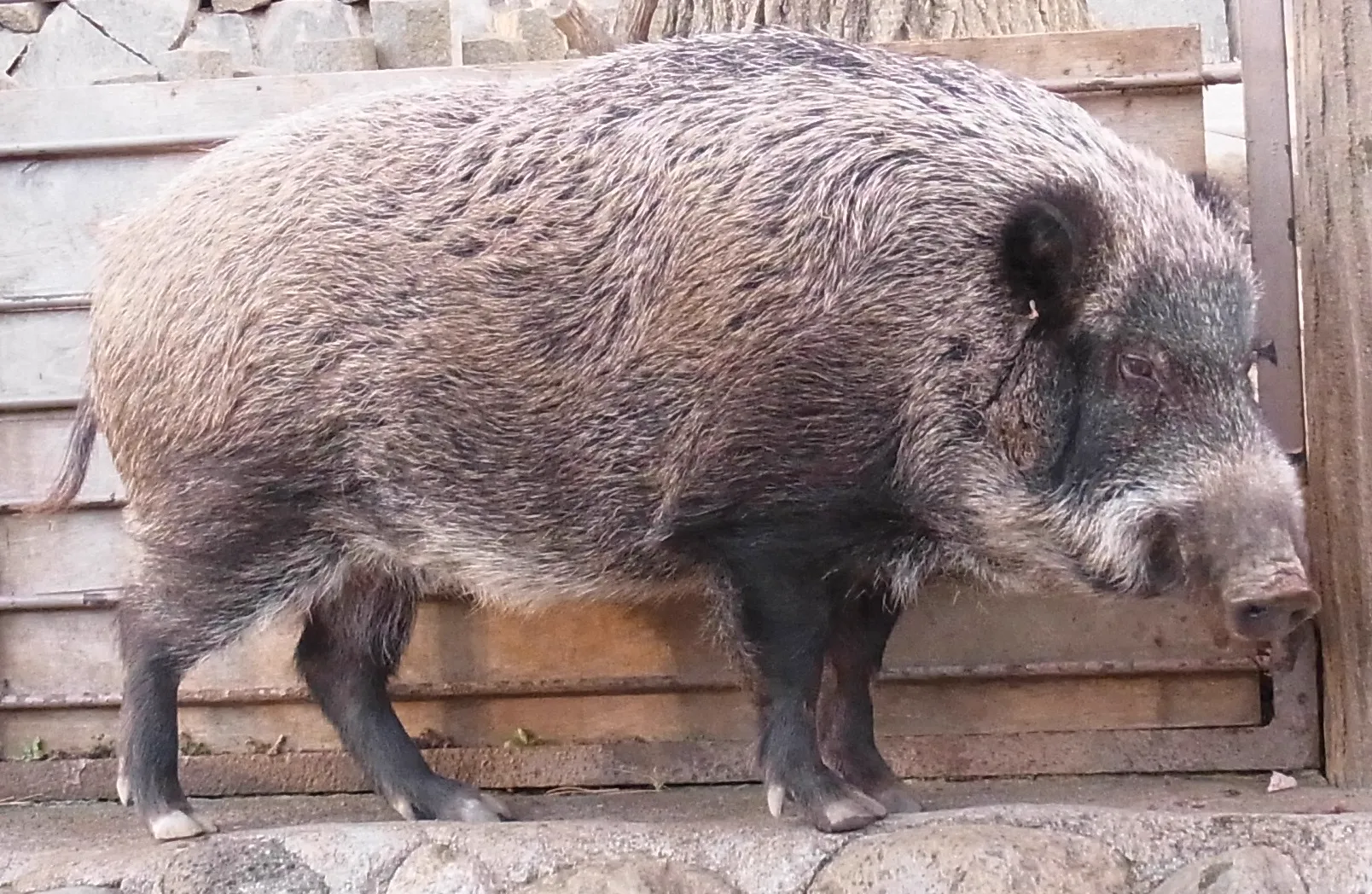
Image credit: Japanese wild boar at Tama Zoo by urasimaru, CC BY 2.0
TL;DR
Classical swine fever (CSF, 豚熱 in Japanese) is a disease of pigs and wild boar. MAFF, Japan’s agriculture ministry, says it has never been reported to infect people through pork or boar meat.
Kanagawa’s list of infection-confirmed zones, current as of 18 March 2024, covers all of Yugawara, Hakone, and Odawara. Yugawara has had 4 positive boar out of 89 tested; the latest was found in Kajiya on 13 August 2025.
Inside a zone, Kanagawa asks people who capture boar to eat the meat themselves and not sell it or give it away. Boar from a zone reaches shops only through a licensed facility that follows MAFF’s guide: each animal is held until a blood PCR test comes back negative, and heads and organs are discarded.
What is an infection-confirmed zone?
Classical swine fever came back to Japan in September 2018, when a pig farm in Gifu had the first outbreak in 26 years. MAFF’s guide on zone gibier names the spread among wild boar as a major driver, and says the disease had reached wild boar in 34 prefectures by March 2023. To slow it, every point where a wild boar tests positive gets a 10-kilometer radius around it, and that area is an infection-confirmed zone (感染確認区域). The rules for boar meat change inside it.
Kanagawa found its first infected wild boar in Sagamihara in May 2020. The prefecture’s table now lists 139 positives out of 3,048 boar tested, and the most recent, from 24 September 2026, was a dead animal in Yamakita. The zone list on the prefecture’s site, current as of 18 March 2024, covers most of western and central Kanagawa, including all of Yugawara, Hakone, Manazuru, and Odawara.
What has turned up in Yugawara?
Yugawara has tested 89 wild boar: 81 captured and 8 found dead. Four were positive. Two were captured in Miyakami, on 11 May 2022 and 17 January 2025. Two were found dead in Kajiya, on 20 June and 13 August 2025. Next door, Manazuru has 10 positives out of 106, all in Iwa, and Hakone has 3 out of 33.
Yugawara Club, our sister site, covers the town side of this: the four cases street by street, and the volunteers in Kawabori who took trap licenses to protect their mikan groves. Both pieces are linked under related media at the end of this page.
Can a trapper keep the meat?
Yes, for their own table, and that is where it stops. Kanagawa’s measures for pest capture inside a zone ask that boar meat be eaten only by the household that took it, with no sale and no gifts. In principle, nothing from the animal leaves the zone. Butchering happens on site or at a properly managed place nearby, only the meat goes home in a sealed container, and meat that will be thrown away is boiled or microwaved through before it goes in the trash.
The rest of the sheet is about not moving the virus. Disinfect the ground within a meter of where the animal was killed, change outer clothes and boots before leaving, disinfect traps and vehicle tires, and stay away from pig farms. The prefecture asks the same cleaning of people trapping other animals in a zone. None of this is a license: catching boar still needs a hunting license or a capture permit. If you find a dead boar in the prefecture’s western district, which includes Odawara, Hakone, Manazuru, and Yugawara, leave it and call the Kensei Regional Administration Center’s environment section at 0465-32-8000 so it can be tested.
How does zone boar reach a menu?
Through a licensed meat-processing facility that follows MAFF’s Guide to gibier use inside infection-confirmed zones, written with MHLW, Japan’s health ministry, in April 2021 and revised in April 2023. It treats every boar from a zone as possibly infected. The facility logs each animal, discards the head and organs, and holds the carcass in a cold store used only for unconfirmed boar, never mixed with deer, until a blood PCR test from the prefecture’s livestock hygiene service center or an approved lab comes back negative.
The storage method sets the cost of a positive. If carcasses are wrapped one by one, only the positive animal is destroyed. If they are stored unwrapped, one positive means discarding everything in that cold store. Facilities that cut and vacuum-pack before the result arrives cannot ship until every animal behind the batch tests negative. The guide also advises against using boar from zones that were just drawn or from areas with a high rate of positives. For a restaurant buying boar, the useful questions are whether the facility is in a zone and which of these methods it runs.
Is the meat safe to eat?
Swine fever is not the risk to you. MAFF states that eating pork or boar has never been reported to give swine fever to a person, and that the oral vaccine baited for wild boar does not affect the safety of the meat. The damage is to pig farming, and that is why the zone rules are about where meat, blood, and boots go.
The usual gibier risks stay. MHLW warns that raw or undercooked venison and boar can carry hepatitis E virus, enterohemorrhagic E. coli, and parasites, so boar is cooked through to the center, and anyone processing it as a business needs a licensed facility. A swine-fever-negative test result says nothing about those hazards.
What this means around Yugawara
For diners, boar on a menu in Yugawara, Hakone, or Atami has to come from a licensed processing facility, and it is fair to ask which one. For residents who trap under a permit, the prefecture’s sheet and its five-minute video are the rules to work by. For anyone walking the hills above the onsen town, a dead boar is a phone call, not a find.
Go deeper
- Japanese wild boar flavor: Ingredient guide
- Gibier handling training: Gibier infrastructure note
- Types of Japanese gibier: Gibier guide
Buy tested boar meat direct
Wild boar from licensed processing facilities in Kumamoto, Miyagi, and Nagano, sold in each producer’s own shop.
See wild boar on saleSources
- Swine fever measures in wild boar, with every positive case in Kanagawa: Kanagawa Prefecture (JA)
- Swine fever infection-confirmed zones and biosecurity measures: Kanagawa Prefecture (JA)
- Biosecurity measures for pest capture inside an infection-confirmed zone: Kanagawa Prefecture (JA)
- Classical swine fever and wild boar: Ministry of Agriculture, Forestry and Fisheries (JA)
- Guide to gibier use inside swine fever infection-confirmed zones (revised April 2023): Ministry of Agriculture, Forestry and Fisheries (JA)
- Hygiene management of gibier: Ministry of Health, Labour and Welfare (JA)
Related video / media
- Yugawara Club (our sister site): the four swine fever cases in Yugawara’s wild boar: Yugawara Club (sister site)
- Yugawara Club (our sister site): the volunteer boar trappers of Kawabori: Yugawara Club (sister site)
- Kanagawa Prefecture video: biosecurity for pest capture in a swine fever zone (about 5 minutes): Kanagawa Prefecture
Need a sourcing check?
Send the specific context behind your decision. A free inquiry checks fit; the paid sourcing assessment works through one concrete question.