Japan’s food-security access problem
Japan’s food-security debate usually starts with production, imports, and farmland. Those matter, but buyers also need a clearer route to find, verify, and buy domestic food that already exists.
By Matt Ketchum, founder and editor
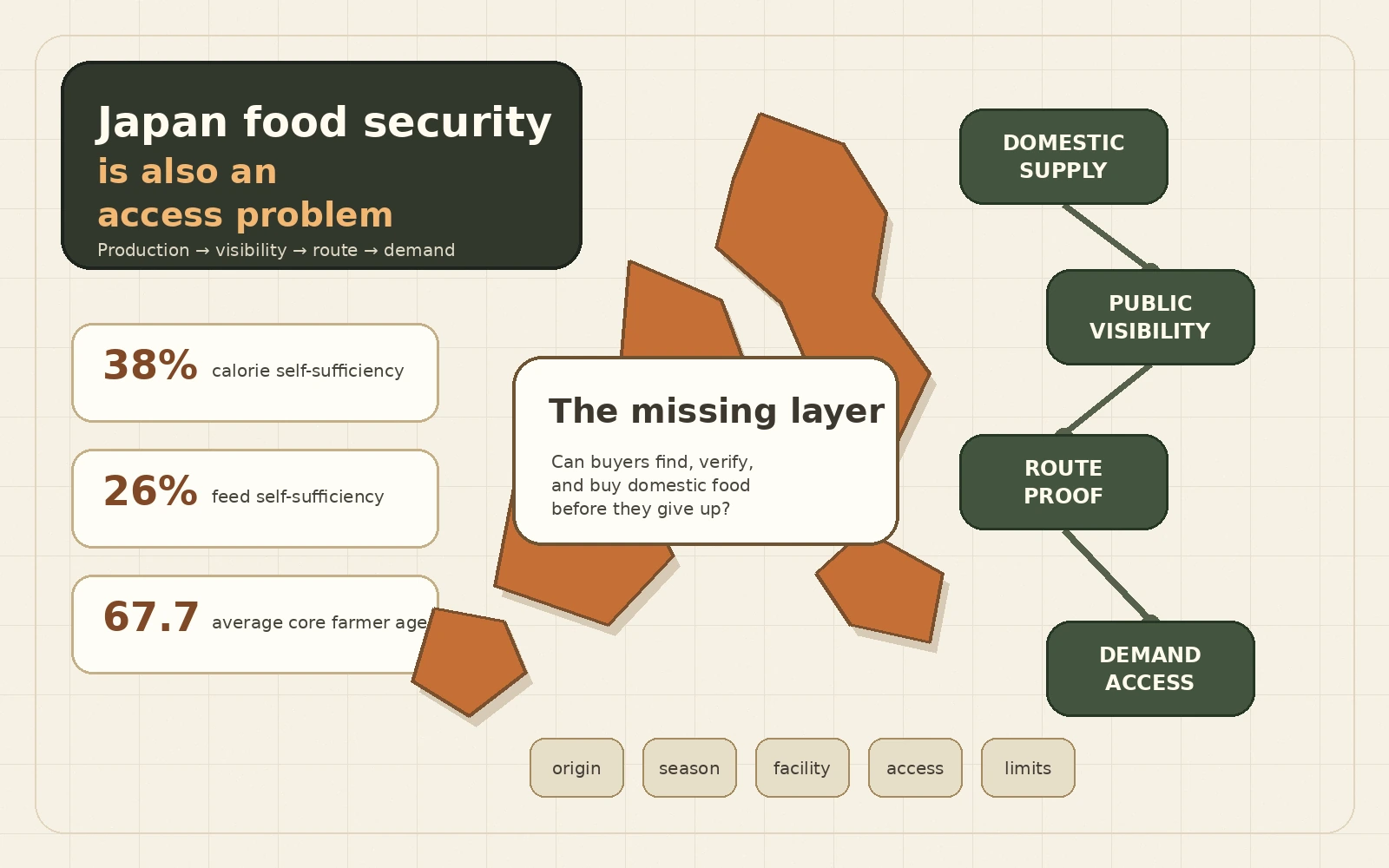
Image credit: Japan food security sourcing access illustration by wildfood.jp, Original site artwork
Short answer
Japan’s food security problem is not only whether the country can produce more food. It is also whether serious buyers can find, verify, and buy the domestic food Japan already produces.
MAFF’s latest numbers show the pressure: fiscal 2024 calorie-basis self-sufficiency was 38%, feed self-sufficiency was 26%, and the 2025 core agricultural workforce was down to 1.036 million people with an average age of 67.7.
In that setting, source visibility is not marketing decoration. It is infrastructure for domestic demand.
Is food security only about production?
Japan usually talks about food security as a production problem: raise domestic output, protect farmland, secure feed, support farmers, reduce import exposure, and make the country less vulnerable to global shocks. That conversation is necessary. MAFF’s own data makes the exposure clear. But production is not the whole system. A country can grow, catch, raise, process, and preserve domestic food, then still fail to turn it into resilient demand if the path between producer and buyer is hard to see.
That is the quieter access problem. Domestic food exists across Japan in farms, fishing ports, processors, local brands, wild game facilities, tea regions, salt makers, rice areas, fruit orchards, livestock operations, co-ops, wholesalers, and restaurants. The problem is that a serious buyer often has to move through old relationships, scattered municipal pages, PDFs, trade habits, phone calls, and local knowledge before a product becomes commercially usable. The food may be domestic. The route may still be opaque.
What do the official numbers show?
The access argument does not replace the production argument. It sits on top of it. The official numbers already show a system with little room for complacency.
- In fiscal 2024, Japan’s calorie-basis food self-sufficiency rate was 38%, with 860 kcal of domestic supply against 2,248 kcal of total daily supply per person.
- MAFF’s newer intake-calorie measure put fiscal 2024 self-sufficiency at 46%, using 1,850 kcal as the denominator for ordinary daily need.
- The production-value self-sufficiency rate was 64% in fiscal 2024. Value-based numbers move with prices as well as physical supply, so the figure is not a simple measure of resilience.
- Feed self-sufficiency was 26%. That matters because domestic meat, eggs, and dairy can still depend on imported feed inside the production chain.
- The core agricultural workforce in individual management entities fell from 1.757 million people in 2015 to 1.036 million in 2025; 721,000 of those workers were 65 or older, and the average age was 67.7.
- New farmers were 43,500 in 2024, down from 60,200 in 2016. Only 15,700 were age 49 or younger.
Can buyers actually reach domestic food?
Those numbers describe production exposure, labor pressure, and input vulnerability. They do not answer a different practical question: when a restaurant, hotel, specialty retailer, processor, or serious home buyer wants domestic food, how quickly can that buyer identify what exists, where it comes from, whether the claim is real, whether it is available now, and how it can be purchased?
That question is not cosmetic. If domestic options are hard to discover, imported or centralized options look efficient by default. If a local product is only visible to insiders, it cannot easily become repeat demand. If origin, processing, season, volume, storage, and purchase route are unclear, buyers fall back into the channel they already know. Bypassing intermediaries is not the question. The question is whether the buyer can see enough of the route to make a serious choice.
Why do managed systems stay opaque?
Japan’s food system is not difficult because nobody is involved. It is difficult partly because many functions are already managed by established layers: cooperative procurement and marketing, wholesale markets, processors, finance, logistics, trading, retail, government programs, and local promotion. Those layers are not useless. Food needs storage, grading, capital, cold chain, aggregation, hygiene, contracts, and risk management. The point is not to pretend a pure direct market can replace the machinery of a national food system.
The sharper problem is that a managed food system is not the same thing as an accessible food system. When the old pipes still move money, operators do not have to compete very hard on visibility. The relationships may be inefficient, but they preserve position. The information may be messy, but the mess does not hurt everyone equally. For people already inside the route, opacity is the operating environment, not a crisis. The architecture has worked long enough that public route information stayed optional.
Is access part of food security?
Food security also includes the ability for domestic demand to find domestic supply before the buyer gives up. That changes the practical work. It means source visibility, route clarity, product information, and purchase path are not soft branding exercises. They are part of the country’s ability to use what it already has.
This is especially important as the producer base ages. A shrinking workforce cannot afford to have usable domestic products hidden behind fragmented information. Buyers also cannot be expected to treat domestic sourcing as strategic if domestic sourcing remains slow, opaque, and relationship-dependent. A serious system reduces friction without pretending every farm, processor, or local product is ready for national-scale demand. Visibility makes limits clearer.
What does better access make visible?
A useful public layer does not need to reveal anyone’s private relationships or sourcing notes. It makes the basic market questions easier to answer in plain language.
- What is the actual product, and what part of the regional claim is specific rather than promotional?
- Where is it produced, processed, or handled, and which parts of that route are visible from public sources?
- Is there an official, near-official, or operational source that supports the origin, hygiene, facility, or production claim?
- Is the product realistically available to buyers now, seasonally, occasionally, or only as local recognition with no clear purchase route?
- Does the route point to a producer, processor, cooperative channel, wholesaler, retailer, restaurant, event, or another public-facing access point?
- What are the obvious limits: volume, season, safety rules, freshness, geography, delivery, processing capacity, or missing public information?
What is the harder question?
If Japan treats domestic food as strategically important, domestic food is easier to find, verify, and buy. Not everything needs to be direct. Not every local product needs to become a national product. Not every gap is a scandal. The gaps stay visible, because invisible gaps become invisible policy failures and invisible market failures.
The useful critique is not that food institutions are evil. It is that managed flows can become comfortable, and comfort can become a strategic weakness. Japan’s food-security problem is therefore also an access problem. The country needs more production capacity, better succession, stronger feed and input resilience, and more efficient farmland use. It also needs a clearer map between domestic supply and domestic demand. Without that map, the old pipes stay inevitable even when better routes already exist.
Go deeper
- MAFF’s June gibier bottleneck: Gibier infrastructure note
- What gibier means in Japan: Gibier guide
- Useful wild food for restaurants: Field note
Sources and further reading
- Fiscal 2024 food self-sufficiency rate materials: Ministry of Agriculture, Forestry and Fisheries (JA)
- Statistics on agricultural labor: Ministry of Agriculture, Forestry and Fisheries (JA)
- Situation around agricultural management, June 2026: Ministry of Agriculture, Forestry and Fisheries (JA)
- Illustration: Japan food security sourcing access illustration: wildfood.jp
Related video / media
Need a sourcing check?
Send the specific context behind your decision. A free inquiry checks fit; the paid sourcing assessment works through one concrete question.