MAFF’s June gibier numbers show the real bottleneck: getting usable animals into the right facilities
MAFF’s June 2026 materials put useful numbers on the gap: 826 processing facilities, 2,678 tons of use, and still only about one in ten captured deer and boar entering formal gibier routes.
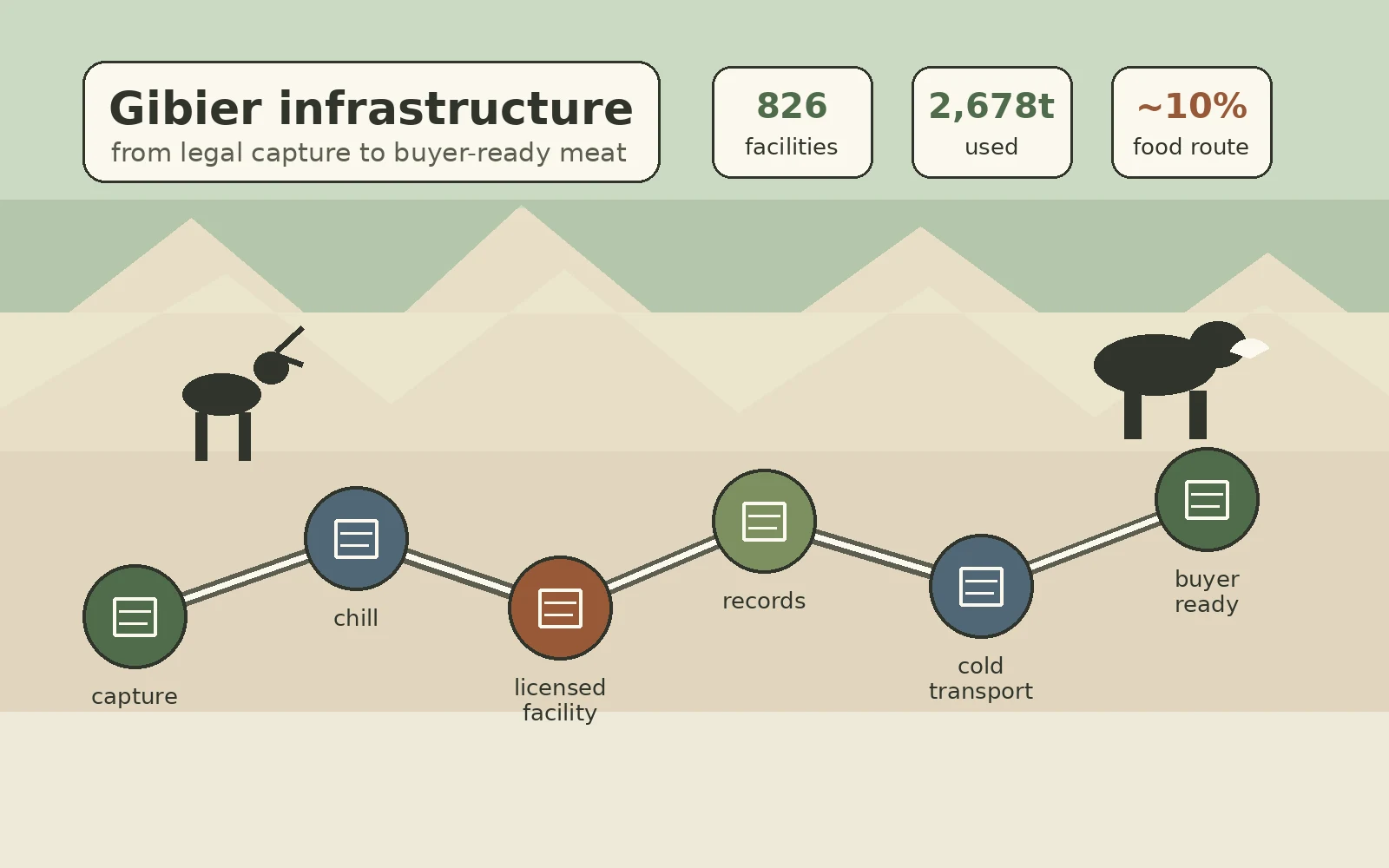
Image credit: Gibier infrastructure route editorial illustration by wildfood.jp editorial artwork, Original site artwork
The June update is not a recipe story
MAFF’s June 2026 materials give the kind of numbers that are more useful than another vague celebration of wild meat. Japan had 826 facilities processing wild bird and animal meat in fiscal 2024, and formal gibier use reached 2,678 tons. That is 2.1 times the fiscal 2016 level, but MAFF still describes the share of captured deer and boar entering food-processing and distribution routes as about one in ten, excluding hunters' private use.
That gap is the story. If a deer or boar is legally captured but cannot be cooled, checked, transported, processed, labeled, and sold through a facility with the right permissions, it is not a reliable food supply. It becomes disposal work, private consumption, or a missed local-resource opportunity.
Wildlife management needs boring infrastructure
The useful argument for gibier is not that eating wild meat solves wildlife conflict. It does not. MAFF’s own materials put gibier inside a wider response: population management, fences and other intrusion prevention, and habitat or village-edge management. Food use is one practical part after lawful capture, not a magic answer before it.
The practical work is boring in the best sense: trained hunters who know which animals are suitable for food, fast transport or chilling, processing capacity, people who can break animals down safely, clear records, traceability, and buyers who understand that not every captured animal should be eaten. Those details decide whether utilization is responsible or just branding.
What buyers should do with the numbers
For restaurants and shops, the June figures are a prompt to ask better questions. Which facility handled the meat? Is it licensed for meat processing? What species, cut, processing date, storage state, and lot information are available? Is there cooking guidance? Can supply repeat, or is this a one-off catch?
MHLW’s guidance stays central here: wild deer and boar meat can carry food-safety risks, and meat for restaurants or retail should come from properly permitted facilities and be cooked thoroughly. Buyer transparency is not paperwork for its own sake. It is how regulated wild meat becomes useful without pretending every wildlife problem can be served on a plate.
Go deeper
- What is gibier in Japan? A practical guide for buyers: Gibier guide
- Wakayama’s winter gibier fair is a supply-chain test, not just a menu campaign: Gibier infrastructure note
- Kuma Village’s new gibier plant is the boring infrastructure Japan needs: Gibier infrastructure
Sources and further reading
- Recent situation around utilization of captured wildlife as gibier, June 2026 edition: Ministry of Agriculture, Forestry and Fisheries (JA)
- Know and enjoy gibier, June 2026 edition: Ministry of Agriculture, Forestry and Fisheries (JA)
- MHLW hygiene guidance for wild game meat: Ministry of Health, Labour and Welfare (JA)
- Hero image: gibier infrastructure route editorial illustration: wildfood.jp
Related video / media
Need this checked for your menu, region, facility, or product?
Send the specific context behind your decision. A free inquiry checks fit; the paid sourcing assessment works through one concrete question.