Gibier handling training
MAFF’s current Gibier Partnership Forum listings point to the practical layer Japan needs: certified facilities, field handling, hygiene training, cold chain, records, and buyer transparency.
By Matt Ketchum, founder and editor
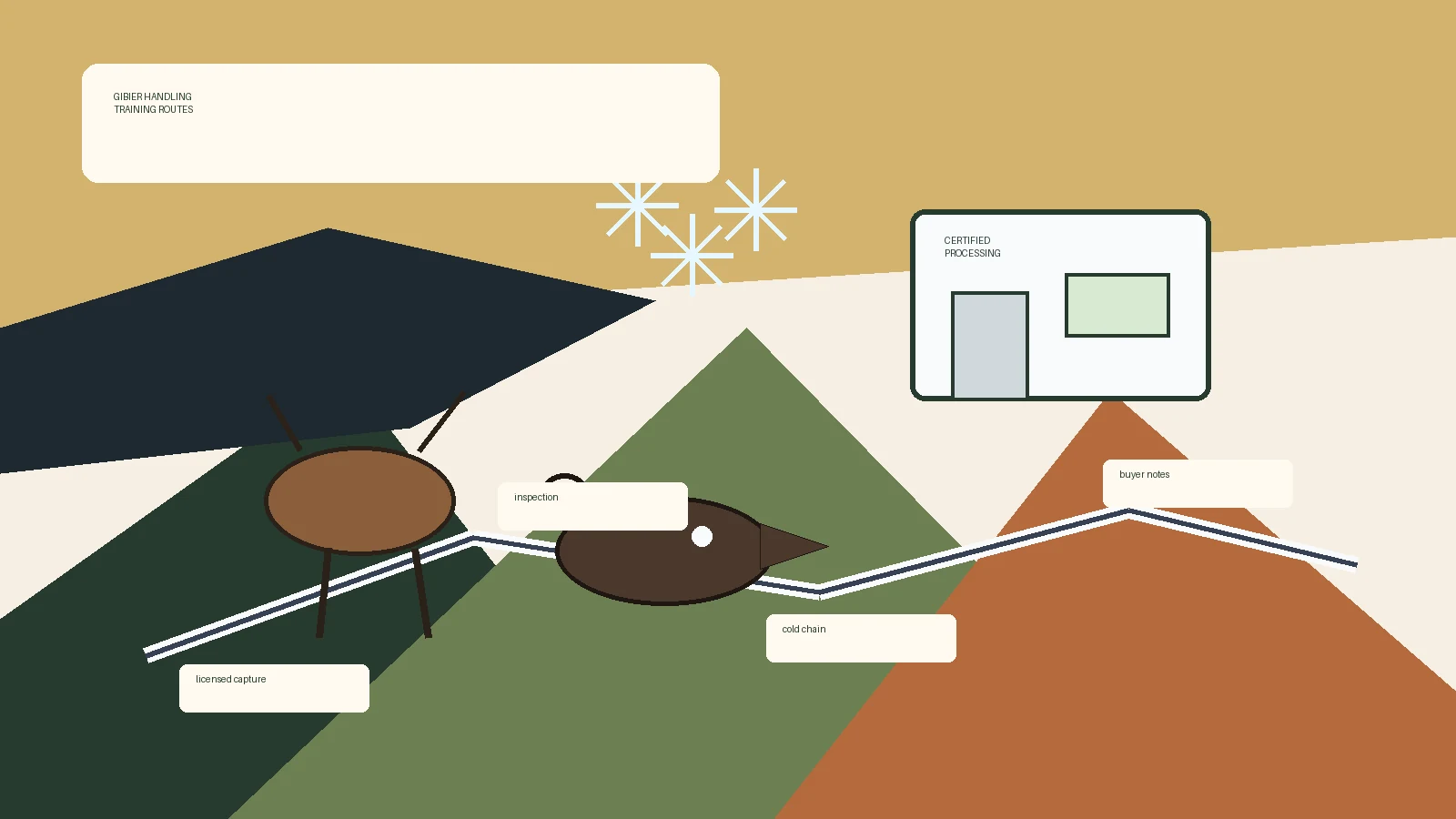
Image credit: Gibier handling training routes illustration by wildfood.jp, Original site artwork
Short answer
Japan’s gibier problem is not solved by telling people to eat more deer or boar. It is solved, if at all, by boring infrastructure: trained capture, hygienic processing, cold chain, records, and honest sales information.
MAFF’s Gibier Partnership Forum is currently listing 2026 training and exchange programs, including a domestic-gibier certification organization course held at certified facilities in Fukuoka, Iwate, Tottori, and Ishikawa.
That matters because wild meat becomes usable only when the route is visible enough for municipalities, hunters, processors, restaurants, and buyers to trust it.
What training does MAFF’s forum offer?
The useful news in MAFF’s Gibier Partnership Forum is not a new recipe or another wild-meat slogan. It is the training layer. The forum currently points to 2026 programs where people can see certified facilities, field handling, dismantling, hygiene management, and the practical questions that decide whether a captured deer or boar can become food at all.
The domestic-gibier certification organization’s notice lists sessions at certified facilities including Itoshima Gibier Kobo in Fukuoka, MOMIJI in Iwate, Wakasa 29 Kobo in Tottori, and Gibier Atelier Kaga no Kuni in Ishikawa. The listed species are mainly deer and boar, with some venue details depending on capture conditions. That is exactly the right level of detail: place, facility, species, time, and handling method.
Why does training matter to buyers?
Japan’s wildlife-management discussion is often pulled toward extremes: panic about damage on one side, promotional gibier language on the other. The actual work sits between them. If a municipality, hunting group, or processor wants utilization to mean more than disposal avoidance, it needs people who know what can be accepted, what must be rejected, how fast cooling has to happen, and how records follow the meat.
Restaurants and shops need the same system in buyer language. They need species, cut, processing date, frozen or chilled state, facility route, lot information, recommended cooking, and a clear answer when the product is not suitable for a menu. Training makes that information less accidental.
Is utilization a cure-all?
Regulated wild meat infrastructure can be one practical part of wildlife management, especially for deer and boar damage where lawful capture is already happening. It can reduce waste, give processors and hunters a clearer role, and let restaurants buy local meat without guessing.
But it is not a magic solution to bear conflict, crop damage, rural labor shortages, habitat change, or public safety. The useful line is narrower: where capture is legal, where food use is appropriate, and where inspection, processing, cold chain, and traceability are strong enough, the route turns eligible animals into accountable food instead of vague opportunity or automatic waste.
Go deeper
- MAFF’s June gibier bottleneck: Gibier infrastructure note
- What gibier means in Japan: Gibier guide
- Kuma Village’s gibier plant: Gibier infrastructure
Sources and further reading
- MAFF Gibier Partnership Forum listings: Ministry of Agriculture, Forestry and Fisheries (JA)
- Recruitment notice for 2026 gibier dismantling and processing training: Domestic Gibier Certification Organization (JA)
- Illustration: gibier handling training routes illustration: wildfood.jp
Related video / media
Need a sourcing check?
Send the specific context behind your decision. A free inquiry checks fit; the paid sourcing assessment works through one concrete question.