Kagoshima’s 2026 gibier demand brief
Kagoshima Prefecture’s May 2026 call for a gibier demand-expansion contractor is small on paper, but it names the real work: stable processing facilities, local deer and boar procurement, events, surveys, and buyer awareness.
By Matt Ketchum, founder and editor
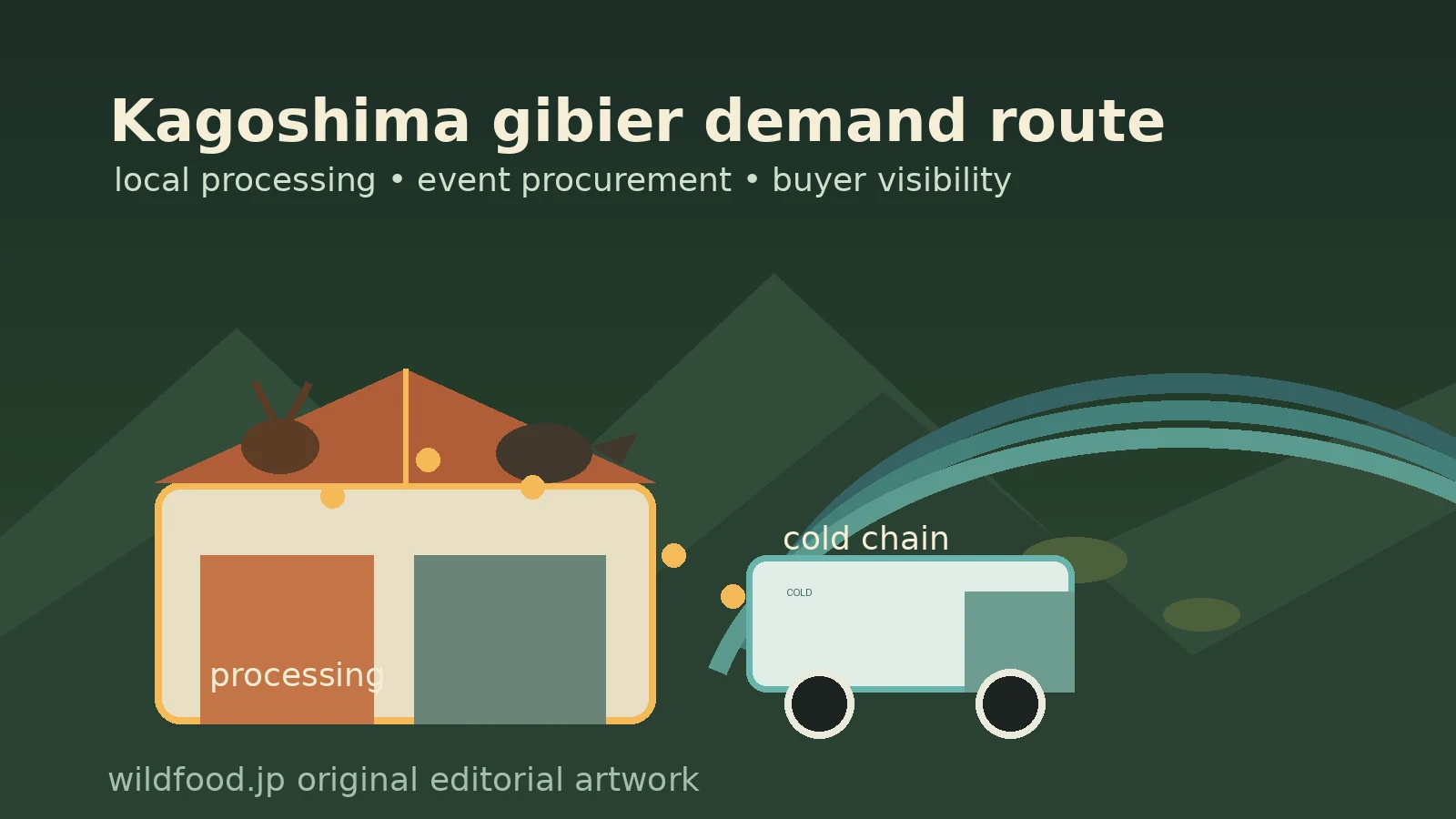
Image credit: Kagoshima gibier demand route illustration by wildfood.jp, Original site artwork
Short answer
Kagoshima Prefecture’s 2026 gibier demand-expansion notice is useful because it treats wild meat as a route problem, not a slogan.
The brief asks for work that connects processing facilities, local deer and boar procurement, public-facing events, PR, surveys, and analysis through a contract running to March 5, 2027.
That is the kind of boring demand infrastructure Japan needs if regulated wild meat is going to reduce waste and become a trustworthy part of wildlife-management response.
What does Kagoshima’s call ask for?
Kagoshima Prefecture updated a public call on May 13, 2026 for a contractor to run its fiscal 2026 gibier demand-expansion project. The deadline for proposals was June 22. On the surface, that is an ordinary procurement notice. For wild food, it is more interesting than that because the prefecture spells out the missing middle: explain the project to processing facilities and related actors, use Kagoshima-produced gibier such as boar and deer, run demand-building activities, publicize them, survey participants, analyze the results, and coordinate the meat used in the project.
That last line matters. A local gibier event is weak if it only asks people to taste a novelty once. It becomes more useful when the brief includes adjustment and procurement of the meat, because then the event has to touch the actual route: which facility handles it, what species are available, whether the product is frozen or chilled, how much can be supplied, and whether buyers can understand the source without guessing.
Why is Kagoshima a practical place?
The notice comes from the prefecture’s rural promotion division, not a lifestyle campaign. That fits the problem. Deer and boar are not just menu ideas; they sit inside farmland damage, mountain access, hunter capacity, processing capacity, hygiene rules, cold chain, and the simple question of whether anyone will keep buying after a festival tent closes.
Kagoshima also has strong food identity already, so the useful gibier question is not whether one more local product can be promoted. It is whether captured wildlife that is legally and hygienically suitable for food can move through a clear enough system to support stable processing facilities. Demand work makes the route visible to residents, restaurants, retailers, and processors. A cheerful poster is not the whole job.
What demand infrastructure does wild meat need?
Regulated wild meat can be one practical part of Japan’s wildlife-management response. It can reduce waste from eligible animals, give licensed hunters and processing facilities a more concrete role, and give buyers access to local meat with origin, handling, and availability made clearer. But that only works when the system is honest about limits: not every animal is suitable, not every area has processing capacity, and promotion without cold chain or records creates more noise than trust.
Kagoshima’s brief is useful precisely because it is not grand. It asks for events, PR, surveys, analysis, and procurement tied to prefectural gibier through a contract period running to March 5, 2027. That is the unglamorous layer where demand becomes measurable, facilities get feedback, and buyers learn what local wild meat can actually be.
Go deeper
- MAFF’s June gibier bottleneck: Gibier infrastructure note
- Gibier handling training: Gibier infrastructure note
- Kuma Village’s gibier plant: Gibier infrastructure
Sources and further reading
- Call for proposals: fiscal 2026 gibier demand expansion project: Kagoshima Prefecture (JA)
- Illustration: Kagoshima gibier demand route illustration: wildfood.jp
Related video / media
Need a sourcing check?
Send the specific context behind your decision. A free inquiry checks fit; the paid sourcing assessment works through one concrete question.