Izu Oshima’s kyon problem
Kyon are a small deer that spread across Izu Oshima after escaping from a park enclosure. Tokyo removes about 7,000 a year and incinerates them. One island producer turns some into meat you can buy.
By Matt Ketchum, founder and editor
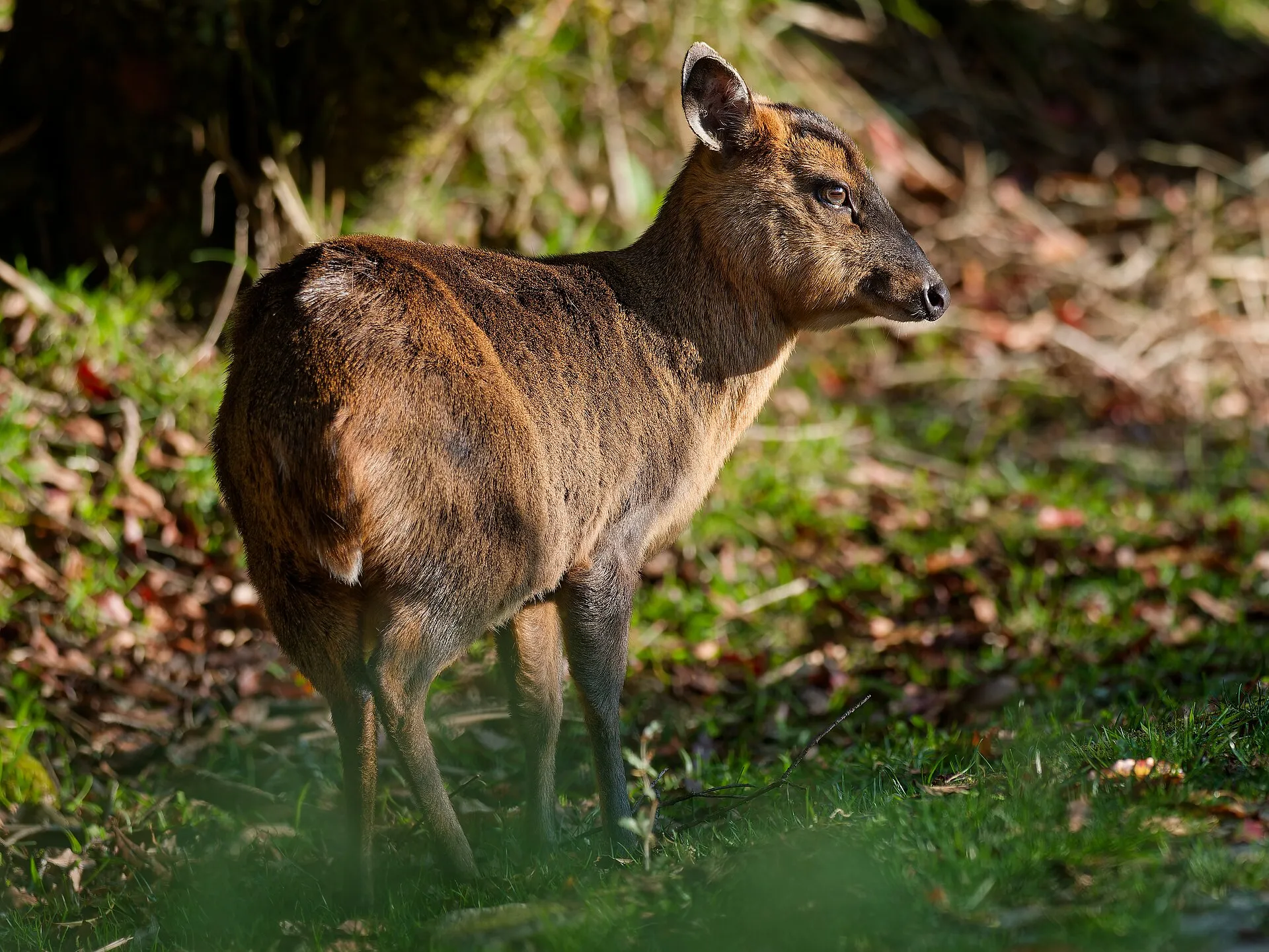
Image credit: Reeves’s muntjac at Dasyueshan by longan Jiang, CC0
TL;DR
Kyon (Reeves’s muntjac) on Izu Oshima are said to descend from animals that escaped from Tokyo’s Oshima Park in 1970, when a typhoon broke their enclosure. They were designated a Specified Invasive Alien Species in 2005.
Tokyo estimates a median of 12,707 kyon on the island at the end of 2025. Captures reached 7,291 in fiscal 2025, and the target for fiscal 2026 is 8,000 or more, with eradication as the final goal.
Tokyo is not considering food use and incinerates captured animals. Izu Oshima Gibier, a kyon specialist on the island, sells cuts through its own BASE shop. Wild game is cooked through to 75°C at the center for at least one minute.
Where did the kyon come from?
Kyon, known elsewhere as Reeves’s muntjac, are a small deer native to southern China and Taiwan. Tokyo’s control plan says about ten or more were brought to the metropolitan Oshima Park as display animals, and that they are said to have escaped in 1970, when a typhoon broke the fence of their enclosure. Breeding in the wild was confirmed three years later, in 1973.
Under the Invasive Alien Species Act, which took effect in June 2005, kyon were designated a Specified Invasive Alien Species. The Ministry of the Environment lists them as established in Japan. Keeping, moving, or releasing them live is restricted.
How many kyon live there now?
Tokyo’s estimates have changed with its counting models, so the figures read best as a range. A 2017 briefing from the governor’s office put the population at 3,582 in fiscal 2006 and 12,961 in fiscal 2015. The previous model estimated 17,439 at the end of 2024. The current hierarchical Bayesian model estimates a median of 12,707 at the end of 2025, with a 95% credible interval of 8,989 to 17,303.
Tokyo’s plan says numbers rose until about fiscal 2019 and have been held in check since, without a large decline. Television reporting in 2025 put the island’s kyon at more than twice its roughly 7,000 people.
| When | Estimate | Source |
|---|---|---|
| Fiscal 2006 | 3,582 | Governor’s briefing, 2017 |
| Fiscal 2015 | 12,961 | Governor’s briefing, 2017 |
| End of 2024 | 17,439 (median) | 4th-period control plan, earlier model |
| End of 2025 | 12,707 (median; 8,989 to 17,303) | Fiscal 2026 implementation plan |
What do kyon damage?
Kyon eat vegetables such as ashitaba and sweet potato, along with garden plants. An Oshima Town survey cited in Tokyo’s plan puts crop losses since fiscal 2007 at roughly ¥2 to 3 million a year, varying widely from year to year.
In the forest, kyon thin the understory, reduce rare plants, have wiped out some rare-plant habitats, and hold back regeneration. In town they eat gardens and potted plants, and traffic accidents involving kyon have been reported since fiscal 2008.
How is Tokyo removing them?
Tokyo has run a control program since fiscal 2007. Its fourth plan runs from April 2026 to March 2031. The goal is to cut numbers sharply for now and, in the end, to eradicate kyon from the island, with fiscal 2026 to 2028 set as a period of concentrated capture.
Crews use firearms, net fences, box traps, corral traps, and leg snares, and fences divide the island into zones. Captures have topped 5,000 every year since fiscal 2020: 6,324 in fiscal 2024 and 7,291 in fiscal 2025. The fiscal 2026 target is 8,000 or more.
Tokyo told TOKYO MX+ in 2025 that it is not considering food use. Captured animals are euthanized and incinerated.
Who turns kyon into food?
Izu Oshima Gibier is a kyon specialist on the island. According to a November 2024 press release, its founder took a hunting license in July 2024, at 19, and opened the business that September. Trade press described the plan as the island’s first kyon meat-processing facility, and the shop says it handles each animal itself from capture to butchery.
It sells kyon by the cut through its own BASE shop: loin, tenderloin, spare ribs, and less familiar cuts. Wild Food Japan lists those products and links to the producer’s cart. The producer takes payment, ships, and handles orders.
How do you cook kyon safely?
Kyon is wild game. The Ministry of Health, Labour and Welfare asks that gibier be cooked through to 75°C at the center for at least one minute, or an equivalent. Restaurants and shops may serve or sell only wild meat butchered at a facility with a meat-processing permit.
Go deeper
- Types of Japanese gibier: Gibier guide
- What gibier means in Japan: Gibier guide
- Japanese venison flavor and use: Ingredient guide
Buy kyon from the producer
Izu Oshima Gibier sells kyon by the cut through its own BASE shop. Our buying guide lists each cut with its price and stock, and links to the producer’s cart. Wild Food Japan does not sell the meat or take payment.
See kyon cuts, prices, and stockSources and further reading
- Tokyo kyon control plan, 4th period: Tokyo Metropolitan Government (JA)
- Tokyo kyon control plan, fiscal 2026 implementation plan: Tokyo Metropolitan Government (JA)
- Kyon countermeasures: Tokyo Metropolitan Government Bureau of Environment (JA)
- The current state of kyon on Izu Oshima (governor’s press conference, May 2017): Tokyo Metropolitan Government (JA)
- List of Specified Invasive Alien Species: Ministry of the Environment (JA)
- Invasive kyon outnumber Izu Oshima’s people more than two to one: TOKYO MX+ (JA)
- A young hunter’s project to open a kyon gibier shop on Izu Oshima: @Press (JA)
- A kyon-only facility to open on Izu Oshima: Gibier Keizai Shimbun (JA)
- About Izu Oshima Gibier: Izu Oshima Gibier (JA)
- Hidden dangers in food (Kosei Rodo, November 2024): Ministry of Health, Labour and Welfare (JA)
- Hygiene management of gibier: Ministry of Health, Labour and Welfare (JA)
Need a sourcing check?
Send the specific context behind your decision. A free inquiry checks fit; the paid sourcing assessment works through one concrete question.